
Becoming a Bullionaire
Becoming a Bullionaire
Silver has been the most popular and used form of money
throughout history.
The great economist, Milton Friedman, described silver, and
not gold, as the primary monetary metal in the world. Today, silver is
believed to be just 8 times more abundant than gold and remains a finite and
very rare precious metal. In fact, the quantity of above-ground,
investment-grade silver, is only slightly more than that of gold bullion held
by governments and banks.
Due to banks and central banks desire to move to purely fiat
currencies and due to silver’s limited supply and high price, the use of silver
as mass-circulation coinage was abandoned over 40 years ago. In effect, silver
went from being used as currency and money to being used as an investment and
store of value and in industrial use.
Today, silver bars and coins are still widely
minted all over the world to meet its increasing demand as a tangible asset and
critical industrial and technological component. With demand expected to
outstrip supply in the coming years, pure silver bars offer potentially
attractive returns for investors.
Therefore, when you buy real silver bars or bullion coins,
you are essentially making the same prudent choices that Emperors, legendary
kings, and prosperous merchants have made throughout history. By allocating a
portion of your savings to silver bars investing in a rare precious metal that
is a store of value with substantial and ongoing global demand.
How Silver Bars Are Made?
Most silver you see as jewellery or coins begins life as a
silver ingot or bar refined from silver deposits found in mines underground. A
little-known fact about silver is that there are very few pure silver mines
worldwide; most silver is produced as a by-product of gold, lead, and other
base metal mining.
Due to its relatively lower value, silver bars are cast more
widely than gold bullion by both private and sovereign mints. The two
precious metals are refined through a similar process, with the most common
forms being poured bars (or cast bars), and minted (or pressed bars). Silver
mines extract the ore and refine it into pure metal through smelting. The
molten metal is ultimately poured or cast into a mould to produce silver ingots
or cast bars.
The word ingot is an old term used to refer to metals and
other elements that are melted and poured into a mould with a specific shape,
usually a rectangular block. Ingots are simply a convenient form of producing
metals or non-metals in a refinery into a form that is suitable for
transportation and storage. Ingots are labeled with basic information such as
weight and the name of the producer and are not meant to be traded as
investment grade metal.
Cast and pressed bars differ in several ways, and both have
unique advantages to suit the preferences of every investor.
As a new investor in silver bars, you might wonder:
Firstly, what’s the difference between poured bars and
minted bars?
Poured or Cast Bars: These types of silver bars
are made by pouring molten silver into a mould, or cast, with the desired
shape. Once the molten silver cools and solidifies, it is removed from the
mould and weighed to ensure it contains the exact amount of silver. The cast
bar is then stamped with the name of the refiner, its purity and gross weight.
Alternatively, a serial number may be stamped on the bar for identification and
authentication purposes.
Cast silver bars do not have as polished and as shiny a
finish as that of minted bars. Instead, they have a rougher, matte finish, and
just like two muffins, no two poured bars are identical.
The process of making cast silver bars is relatively simple
but can be costly when producing numerous small bars. This is because it
involves a tremendous amount of energy to melt the silver, and a lot of labour
to painstakingly pour molten silver into each mould.
Pouring bars is only cost-efficient when casting large bars
of more than 100 ounces. Large bars, like the 1000-ounce bars traded
by governments and banks and investment funds, are almost always made through
the casting method. For smaller bars of less than 100 ounces, the pressing or
minting method is commonly used.
Minted or Pressed Bars: The process of minting
silver bars does not involve heating the metal past its melting temperature.
Rather, it begins with silver blanks; large pieces of silver shaped as bars or
rounds without any markings. A pressing or stamping machine is then used to
apply large amounts of pressure to the blanks using a die containing the
desired design. The die typically has intricate logos or elaborate designs and
creates an attractive and glossy finish.
Smaller minted bars can be produced quickly and cheaply
using this process because it does not require lots of labour or energy to heat
the silver. However, large bars of more than 100 ounces cannot be produced
efficiently via this process.
The choice between cast or minted bars will, therefore,
depend on the preference of the investor as well as the cost differences
between minting and casting of the silver bars. Generally, bars larger than 100
ounces will be cast bars while smaller bars will be pressed bars.
Silver bars can also be made by heating the metal to soften
it, before forcing it through a circular or rectangular space to produce an
evenly shaped length of silver, which is then cut into smaller sizes and before
stamping. This is known as extruded silver.
How to Determine the Purity of Silver?
Over the 4000-year history of silver, refiners have used
varying methods to improve the purity of silver and therefore its quality.
Today, advanced technology can produce silver with a purity of 99.99%.
The fineness of silver is denoted using the millesimal
system, where 99.9% of silver represents 999 parts for every 1000 parts, or 999
fineness. Sterling silver, the highest purity in silver jewellery, consists of
92.5% silver and 7.5% copper, is denoted as 925 fineness.
The karat system used for gold, where 99% purity represents
24 parts out of 24 karats, was previously applied to silver. Today, silver bars
or coins are stamped only with the millesimal denotation, with the karat system
remaining optional.
Bullion silver bars and coins have one thing in common; they
are made from pure silver with at least 999 fineness. Also known as
investment-grade silver, bars and coins are vastly different from silver
jewellery and other collectibles.
Silver, just like gold, must be 99.9 percent pure, or .999,
sometimes referred to as “three nines fine” to be considered as investment
grade. Silver bars of such high purity will be accepted as a financial asset by
leading exchanges, and can be traded as an investment by governments, banks,
and individual investors alike. Investment grade silver, therefore, only
derives its value from the weight and purity of its silver content. This is
unlike silver collectibles including numismatic coins, which may not be 999
silver, and whose value derives more from their historic significance and
rarity, rather than their silver content.
To be used in jewellery or as mass-circulation coinage,
silver must be alloyed with a different metal to strengthen and make it more
resistant to scratches and other damage. Copper is usually employed for this
purpose because it does not tarnish nor alter the colour of silver.
Because silver jewellery is alloyed to other metals, its
value is based mainly on the craftsmanship employed and not its silver content.
It, therefore, does not offer much in terms of investment value.
Also read: How much does a silver coin weigh?
How to Measure the Weight of Silver Bars?
The weight of bullion silver, like that of every other
precious metal is measured in troy ounces as opposed to regular ounces. The
regular ounce, is equivalent to 28.35 grams and is used in commerce to measure
every item including common goods like sugar and salt. A troy ounce is
equivalent to 31.1035 grams. Silver bullion is generally measured and priced in
dollars, euros or pounds sterling etc. per troy ounce.
Also read: How much does a silver bar weigh?
Since the 16th century, the troy ounce has been the official
measure of all precious metals such as silver, gold, platinum, and palladium.
It is heavier than the regular ounce and measures 31.07 grams
Popular mints
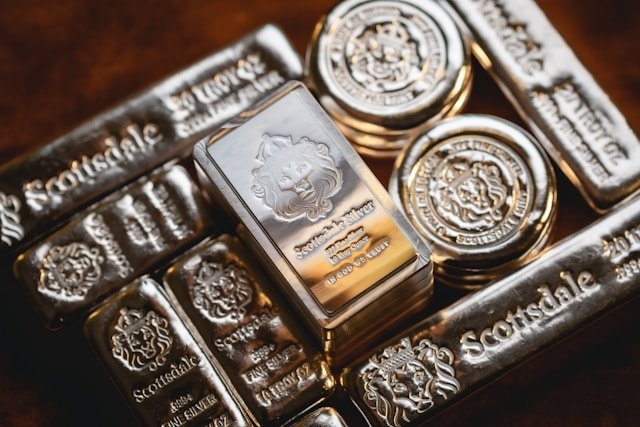
Popular silver bars are manufactured by recognised private
and sovereign mints which include:
What are the types of Silver Bars?
Silver bars, just like coins, are a great option for every
type of investor. Although most people associate silver bars with government or
bank stockpiles, individual investors can also conveniently buy bullion bars
and benefit from the investment advantages that they offer.
Silver bars come in different sizes, from the smaller 1g
bars, 10g bars, and 100g silver bars and up to 1000-ounce silver bars.
Furthermore, cast bars have a deeper profile than stamped bars and appear
thicker and shorter in length and width.
The most popular silver bars are the large silver bars as
they are the best value for investors and more liquid than smaller bars.
Smaller investors tend to favour silver coins (1 oz) rather than
small silver bars.
Other silver bars which can be bought are:
What are the Benefits of Silver Bars Over Coins?
Silver bullion bars and coins both offer exposure to the
silver market, and an opportunity to hedge against risk while profiting from
price appreciations. However, for every investor, the choice between bars or
coins will depend on several factors that include:
Based on the above factors, investing in silver bars rather
than bullion coins will have the following advantages:
Becoming a Bullionaire
Gold vs Silver: 4 Key Differences You Should Know

The Pros and Cons of Investing in Silver
10 Reasons to Invest in Silver